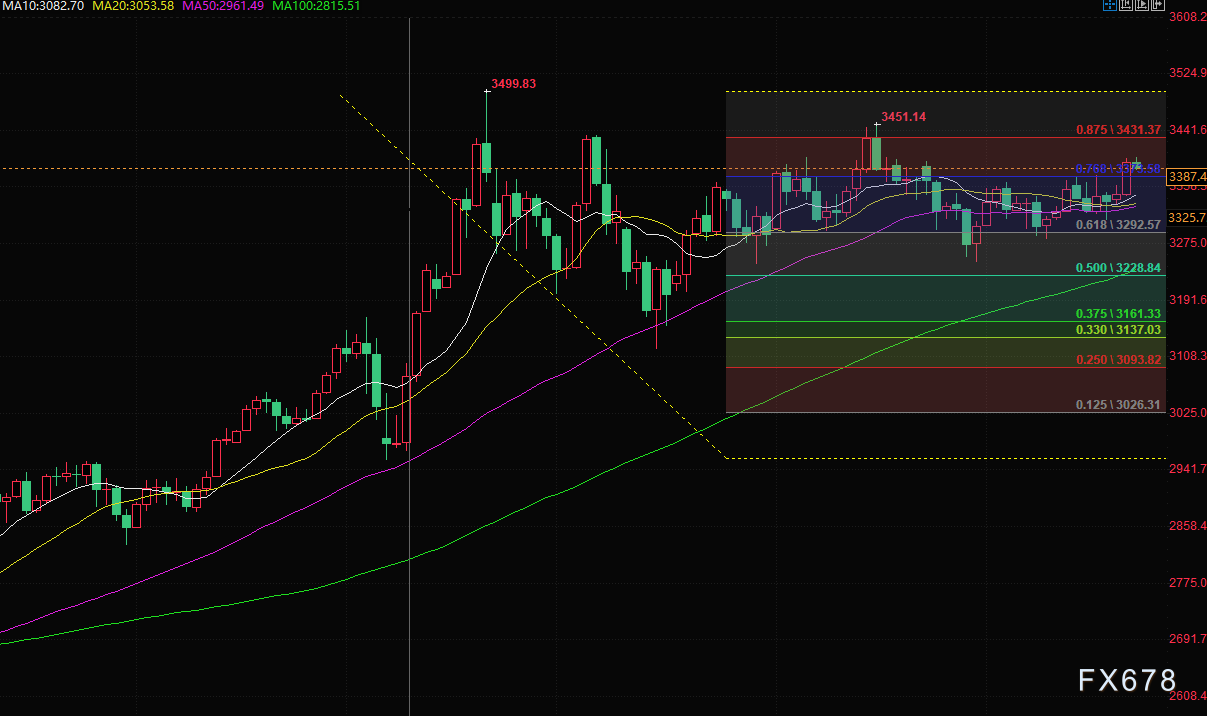
Huitong Finance APP News - On Tuesday (July 22nd), the gold price in the early Asian trading session touched a high of over a month at $3,403 before retreating. Currently, it is trading around $3,386.33 per ounce. The buyer is taking a break for the time being, waiting for clear news on the potential trade agreement in the United States before the August 1st deadline. The US dollar consolidated its downward trend amid tariff uncertainties and concerns over the Federal Reserve. Gold prices closed above the key Fibonacci resistance level on Monday, and any downside seems limited.
The gold price has pulled back but has not been eliminated
The latest pullback in gold prices may stem from two aspects: one is the profit-taking following Monday's nearly 1.5% rise, and the other is the market's early wait and see as US tech giant Alphabet is set to release its key financial report on Wednesday. The pause in the decline of the US dollar and US Treasury yields has also put pressure on gold denominated in US dollars. Facing US President Donald? The fate of gold prices in Trump's tariff negotiations depends on the performance of the US dollar. On Monday this week, the uncertainty of the trade agreements between the United States and Japan as well as the European Union (EU) intensified, reigniting concerns over the growth of the US economy, which put heavy pressure on the US dollar.
The Wall Street Journal reported on Monday, citing sources, that "US officials have informed the EU trade commissioner that President Trump may demand further concessions in the ongoing trade negotiations, including raising the benchmark tariffs on most European goods to 15% or higher, a significant increase from the previously discussed 10%."
Eu diplomats pointed out that as doubts about reaching an agreement rise, the EU is studying a series of possible countermeasures against the United States. Meanwhile, political instability in Japan has cast a shadow over the trade agreement to be reached between the United States and Japan before the August 1 deadline.
Furthermore, as Trump has repeatedly called on Federal Reserve Chair Jerome Powell's resignation has raised persistent concerns over the independence of the Federal Reserve, and the decline in US Treasury yields has also put pressure on the US dollar.
The record rise in the Wall Street index has also weakened the safe-haven and yield appeal of the US dollar, helping the gold price to continue its rally from last Friday.
The core factors influencing the price of gold
The trend of gold prices is closely related to the performance of the US dollar, and the US dollar is influenced by multiple factors:
The uncertainty of trade agreements between the US and Europe, as well as between the US and Japan: The stalemate or intensification of tariff negotiations may weaken the credit of the US dollar and boost the safe-haven demand for gold.
Us Treasury yields: A decline in yields will reduce the appeal of the US dollar and indirectly benefit gold.
Fed policy expectations: Trump's concerns over the Fed's independence intervention may affect the market's judgment on the US dollar and interest rates, and thereby influence the trend of gold.
Market sentiment: The rise of the Wall Street index will divert safe-haven funds, but if trade and policy uncertainties intensify, the safe-haven attribute of gold will once again stand out.
Technical analysis: Bulls still have the upper hand
From the daily chart, the gold price closed above the 23.6% Fibonacci retracement level ($3,373) of the record rally in April on Monday. Meanwhile, the gold price has remained firmly above all major simple moving averages. Despite the latest decline, the 14-day Relative Strength Index (RSI) still stays above 50. Therefore, the technical outlook is favorable for gold buyers. If it can hold above the $3,400 mark, it is expected to challenge the static resistance level around $3,440.
On the contrary, if the pullback continues, the gold price may test the support level of $3,377, which has been transformed from the previous resistance level. After breaking below this level, the $3,330 area (the intersection of the 21-day and 50-day moving averages) may provide support. Bears need to hold their ground below this demand area before they can test the 38.2% Fibonacci retracement level ($3,292) of the same rally and then aim for the July low of $3,283.