

Annealed Wire
Why Choose Us?
Quality products
We have advanced production and testing equipment, and our products meet various standards.
Rich experience
We have years of industry experience and a team of experienced engineers and technicians to ensure consistent precision and high quality of our products.
Reliable service
Our team is committed to providing reliable and consistent service, ensuring that you receive high-quality products and customer support from us every time.
Professional team
The company is in possession of numbers of senior engineers and has abundant technique power, well conditioned equipment and technology comes to perfection.
-
![Xiangtai BWG 10-16 Black Annealed Round Hole Welded Iron Wire With Bending & Cutting Services For Fence Application]() Xiangtai BWG 10-16 Black Annealed Round Hole Welded Iron ...Annealed wire is a type of metal wire that has undergone a specialized heat treatment process, endowing it with excellent elasticity and flexibility. Production Process: The manufacturing...read more
Xiangtai BWG 10-16 Black Annealed Round Hole Welded Iron ...Annealed wire is a type of metal wire that has undergone a specialized heat treatment process, endowing it with excellent elasticity and flexibility. Production Process: The manufacturing...read more -
![BWG 16 High Tensile Black Annealed Welded Wire - Multipurpose Fence Application With Custom Cutting & Bending Services]() BWG 16 High Tensile Black Annealed Welded Wire - Multipur...Annealed wire is a type of metal wire that has undergone a specialized heat treatment process, endowing it with excellent elasticity and flexibility. Production Process: The manufacturing...read more
BWG 16 High Tensile Black Annealed Welded Wire - Multipur...Annealed wire is a type of metal wire that has undergone a specialized heat treatment process, endowing it with excellent elasticity and flexibility. Production Process: The manufacturing...read more -
![BWG 10 BWG 12 BWG 14 BWG 16 Black Annealed Welded Iron Wire With Bending & Cutting Services For Fence Application]() BWG 10 BWG 12 BWG 14 BWG 16 Black Annealed Welded Iron Wi...Annealed wire is a type of metal wire that has undergone a specialized heat treatment process, endowing it with excellent elasticity and flexibility. Production Process: The manufacturing...read more
BWG 10 BWG 12 BWG 14 BWG 16 Black Annealed Welded Iron Wi...Annealed wire is a type of metal wire that has undergone a specialized heat treatment process, endowing it with excellent elasticity and flexibility. Production Process: The manufacturing...read more -
![Black Annealed Welded Iron W Ire For Fence Construction Durable With Bending And Cutting Services]() Black Annealed Welded Iron W Ire For Fence Construction D...Annealed wire is a type of metal wire that has undergone a specialized heat treatment process, endowing it with excellent elasticity and flexibility. Production Process: The manufacturing...read more
Black Annealed Welded Iron W Ire For Fence Construction D...Annealed wire is a type of metal wire that has undergone a specialized heat treatment process, endowing it with excellent elasticity and flexibility. Production Process: The manufacturing...read more -
![BWG 14 BWG 16 Black Annealed Welded Iron Wire With Bending & Cutting Services For Fence Application]() BWG 14 BWG 16 Black Annealed Welded Iron Wire With Bendin...Annealed wire is a type of metal wire that has undergone a specialized heat treatment process, endowing it with excellent elasticity and flexibility. Production Process: The manufacturing...read more
BWG 14 BWG 16 Black Annealed Welded Iron Wire With Bendin...Annealed wire is a type of metal wire that has undergone a specialized heat treatment process, endowing it with excellent elasticity and flexibility. Production Process: The manufacturing...read more -
![BWG 12 Black Annealed Welded Iron Wire For Fence Application With Bending And Cutting Services]() BWG 12 Black Annealed Welded Iron Wire For Fence Applicat...Annealed wire is a type of metal wire that has undergone a specialized heat treatment process, endowing it with excellent elasticity and flexibility. Production Process: The manufacturing...read more
BWG 12 Black Annealed Welded Iron Wire For Fence Applicat...Annealed wire is a type of metal wire that has undergone a specialized heat treatment process, endowing it with excellent elasticity and flexibility. Production Process: The manufacturing...read more -
![BWG 10 12 Black Annealed Welded Iron Wire With Round Hole For Fence Bending & Cutting Services]() BWG 10 12 Black Annealed Welded Iron Wire With Round Hole...Annealed wire is a type of metal wire that has undergone a specialized heat treatment process, endowing it with excellent elasticity and flexibility. Production Process: The manufacturing...read more
BWG 10 12 Black Annealed Welded Iron Wire With Round Hole...Annealed wire is a type of metal wire that has undergone a specialized heat treatment process, endowing it with excellent elasticity and flexibility. Production Process: The manufacturing...read more -
![Black Annealed Welded Iron Wire With Round Hole For Fence Construction Model 12# Xiangtai With Bending Cutting Services]() Black Annealed Welded Iron Wire With Round Hole For Fence...Annealed wire is a type of metal wire that has undergone a specialized heat treatment process, endowing it with excellent elasticity and flexibility. Production Process: The manufacturing...read more
Black Annealed Welded Iron Wire With Round Hole For Fence...Annealed wire is a type of metal wire that has undergone a specialized heat treatment process, endowing it with excellent elasticity and flexibility. Production Process: The manufacturing...read more -
![Factory Supply Common Iron Nails 2 Inch 2.5Inch Construction Common NailsBWG12 Iron Wire Black Annealed Round Hole 4mm Welded Fence Binding Wire Bending Cutting Services Xiangtai]() Factory Supply Common Iron Nails 2 Inch 2.5Inch Construct...Annealed wire is a type of metal wire that has undergone a specialized heat treatment process, endowing it with excellent elasticity and flexibility. Production Process: The manufacturing...read more
Factory Supply Common Iron Nails 2 Inch 2.5Inch Construct...Annealed wire is a type of metal wire that has undergone a specialized heat treatment process, endowing it with excellent elasticity and flexibility. Production Process: The manufacturing...read more -
![Mild Carbon Steel Wire Black Annealed Iron Wire 4mm Steel Binding Wire]() Mild Carbon Steel Wire Black Annealed Iron Wire 4mm Steel...Annealed wire is a type of metal wire that has undergone a specialized heat treatment process, endowing it with excellent elasticity and flexibility. Production Process: The manufacturing...read more
Mild Carbon Steel Wire Black Annealed Iron Wire 4mm Steel...Annealed wire is a type of metal wire that has undergone a specialized heat treatment process, endowing it with excellent elasticity and flexibility. Production Process: The manufacturing...read more -
![8# 10# Black Annealed Welded Iron Wire For Fence Construction Durable With Bending And Cutting Services]() 8# 10# Black Annealed Welded Iron Wire For Fence Construc...Annealed wire is a type of metal wire that has undergone a specialized heat treatment process, endowing it with excellent elasticity and flexibility. Production Process: The manufacturing...read more
8# 10# Black Annealed Welded Iron Wire For Fence Construc...Annealed wire is a type of metal wire that has undergone a specialized heat treatment process, endowing it with excellent elasticity and flexibility. Production Process: The manufacturing...read more -
![Black Annealed Welded Iron Wire For Fence Construction With Bending And Cutting Services]() Black Annealed Welded Iron Wire For Fence Construction Wi...Annealed wire is a type of metal wire that has undergone a specialized heat treatment process, endowing it with excellent elasticity and flexibility. Production Process: The manufacturing...read more
Black Annealed Welded Iron Wire For Fence Construction Wi...Annealed wire is a type of metal wire that has undergone a specialized heat treatment process, endowing it with excellent elasticity and flexibility. Production Process: The manufacturing...read more


What Is Annealed Wire
Annealed wire is steel wire that has undergone a heating and cooling treatment to change its chemical and physical properties. To make this kind of wire, manufacturers heat a low-carbon steel wire to a specific temperature. Then, they cool it at a specific rate to prevent cracking within the steel.
Benefits of Annealed Wire
Annealing wire, also known as thermal wire, is a type of wire that has been heated and then cooled slowly to increase its flexibility, strength and durability. Here are some advantages of annealing wire.
Improved tensile strength
Annealing wire undergoes a process that changes its crystal structure, making it more flexible and increasing its tensile strength. This means that when used in applications that require high levels of strength and durability, like industrial settings, it can perform better and be less likely to fail.
Increased ductility
As a result of the annealing process, the wire becomes more ductile, meaning it can be bent or shaped without breaking. This feature makes it ideal for use in applications where the wire needs to be shaped into specific forms or designs. It is also more resistant to cracking, making it suitable for use in harsh environments.
Enhanced resistance to oxidation and corrosion
Annealed wire has a reduced tendency to oxidize and is more resistant to corrosion due to its unique crystal structure. This makes it ideal for use in applications where it will be exposed to harsh environmental elements, like saltwater or chemicals.
Reduced risk of fatigue failure
Due to its higher tensile strength and increased flexibility, annealed wire is less likely to experience fatigue failure. This makes it suitable for use in applications where it undergoes repeated cycles of stress and strain, like in the construction of suspension bridges.
Better electrical conductivity
Annealed wire has better electrical conductivity than non-annealed wire, which makes it ideal for use in applications where electrical conductivity is important, like in the production of electronic devices.
Applications of Annealed Wire
Since annealed wire has different chemical and physical properties than regular steel, it provides a few advantages in some applications. The annealed wire manufacturing process gives it the flexibility necessary in many industries, including agriculture, construction, manufacturing and more. Here are some of the common uses for annealed wire.
Baling: Agricultural companies use annealed wire for baling hay, branches and other materials. Annealed wire is ideal for these applications because it is sturdy, yet flexible. Annealed wire will also stay in place once bent to a specific shape. Adding oil coating helps annealed wire move smoothly through automatic baling machines.
Tying: Annealed steel wire helps secure various loads by allowing the materials to stretch and expand. For example, recycling centers tie bundles of scrap paper, cardboard and metal with annealed wire. Manufacturers also use annealed wire to bind, bale and tie their materials and products.
Packaging: Product manufacturers use annealed wire to secure packages during shipping because the wire provides security and flexibility. Some facilities also use the material in wire mesh to create packaging molds.
Securing equipment: The mining industry sometimes uses annealed wire to hold equipment in place.

Annealed tied wire come in many variations, depending on the technology used in their manufacture. The types available include:
Black annealed wire: Black annealed wire is named for its distinctive black color, which comes from the corrosion-resistant surface coating added after the annealing process. It is used in a wide range of industrial and consumer applications, including baling and hand fabrication.
Bright Wire: Bright annealed wire presents a shiny and smooth finish. It is commonly used for binding and strapping applications.
In addition to black and bright variants, annealed wire is available in a variety of gauges (i.e., wire diameter), forms (e.g., straight-cut, looped, coiled, and U-shaped), and packaging options (e.g., commercial, boxed) wire and tie wire).
Commercial wire: Several large coils of annealed wire wrapped around a holder.
Boxed wire: Smaller, tighter coils of annealed wire packaged individually into boxes.
Bundled wire: Annealed wire for bundling applications (packaged as commercial wire or box wire).
How Is Annealed Wire Made
The wire is used throughout the industry for a wide range of applications, from binding and securing small products together, to providing framing and support for large structures. Manufacturers accommodate all of these applications by manufacturing wire with different shapes, sizes, flexibility, and formulations to fit a variety of requirements and constraints. One of the most common types of wire is annealed wire.
Annealed wire (also known as annealed tied wire) is mild steel wire that has been annealed to increase its ductility and reduce its hardness. These qualities provide greater flexibility without loss of durability, combining to give the wire self-binding and self-locking capabilities. It is available in several variants, each offering unique properties that make it suitable for different use cases.
Annealing is a heat treatment process that involves heating a material above its recrystallization temperature and then cooling it back to room temperature. The cooling phase for ferrous materials (such as steel) is slower than for non-ferrous materials (such as brass and copper) to prevent the metal from cracking or becoming brittle.
Many metalworking processes increase the hardness of the material, which can make it more difficult to complete subsequent manufacturing operations. Annealing increases the ductility and decreases the hardness of the material, resulting in better formability and machinability. These qualities are critical for many wire applications.
The manufacturing process for annealed wire is as follows.
● Forming the wire from steel (usually mild steel).
● Heating the wire to a point above the crystallization point of the base material but below its melting point.
● Gradually cooling the heated material to below its crystallization point.
● Oiling to prevent rusting and facilitate mechanical distribution (for black annealed wire).
● Annealing Process for Coastal Wire.
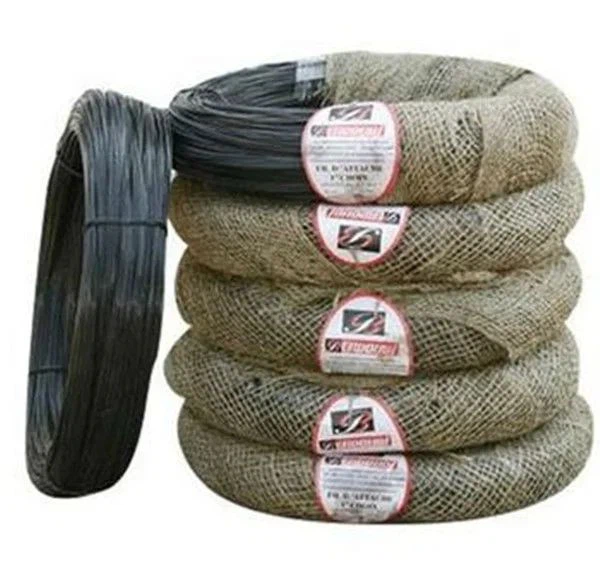
Galvanized Wire Vs. Annealed Wire
How do you decide which wire is better for your application? You must consider your operation's circumstances and requirements to choose the wire that best suits your needs. Consider the critical differences between the two types of wire
Rust resistance
Some applications require enhanced resistance to weather damage. If the wire for your application will be out in the elements, annealed wire might not be the best choice. Making annealed wire changes the steel's physical properties, making it more prone to rust if used outdoors or in wet conditions.
Will galvanized wire rust? Galvanized wire is much more resistant to rust than annealed wire. If your application will expose the wire to weather and salt like in shipyards, galvanized steel wire is better than annealed wire.
Flexibility
The manufacturing process of annealed wire makes it more flexible than regular steel wire. This characteristic makes annealed wire more versatile than wire that has not undergone this process. Annealed wire would be an ideal choice when high flexibility is essential. In contrast, galvanized wire is sturdier and has less adaptability.
Durability
Because of its water and damage resistance, galvanized wire offers more durability than annealed wire in specific conditions. Provides better corrosion resistance than galvanized wire due to the addition of aluminum.
Different Types of Annealed Wire,Which Would You Choose
The black annealed wire is drawn from Q195 low carbon steel wire rod into black wire, then calcined at a high temperature of about 1000° for a sufficient time, and then cooled at an appropriate speed. The purpose is to reduce the hardness and increase the flexibility of the wire. It is softer and more flexible than ordinary black iron wire, with uniform softness and consistent color. After annealing, the wire becomes softer and more flexible, very suitable for building binding,rebar tie wire, garden baling wire, wire mesh weaving, etc.
Annealed wire is classified according to color, and is divided into black annealed wire and white annealed wire (also called soft cooked wire,Italian is called filo cotto bianco), both of which can be used as binding wire. The difference lies in the color and elongation. The surface of white annealed wire is clean, free of impurities, and its color is white. The advantage of black annealed wire is its low price, and it is often used as rebar tie wire.
The anneal wire is classified according to the shape, and is divided into black annealed bulk wire and small coil annealed wire. Black annealed bulk wire each roll weighs 500-1000kg, and the winding state of the wire is unwrapped from the upper side to the bottom of the roll instead of from the outer to the inner,so it can save time and effort. The small coil annealed wire weighs 1-25kg per roll, and has the advantage of being light and easy to carry.
There is also a kind of annealed wire,coil wire, which is neatly arranged, compact, clean and tidy in appearance, and has a small coil diameter. It is mostly suitable for garden binding and daily binding.
The above are the five types of annealed wire. We can choose the appropriate annealed wire according to its coil weight, color, elongation and the usage etc.
How to Use Annealed Wire for Garden Tying
Securing Plants: Annealed wire can be used to secure plants to stakes or trellises, providing support and preventing them from leaning or falling. Start by driving a stake into the ground near the plant, making sure it is positioned appropriately to support the plant's growth. Gently tie the stem or branch to the stake using the annealed wire, creating a loop around the stem and securing it to the stake. Be careful not to tie the wire too tightly to avoid damaging the plant.
Creating Trellises: Annealed wire is ideal for creating trellises to support climbing plants, such as vines or tomatoes. Begin by installing sturdy posts or frames to form the structure of the trellis. Then, attach the annealed wire horizontally or diagonally between the posts, leaving sufficient space for the plants to grow and cling onto the wire. Secure the wire at each end by wrapping it around the posts and twisting it tightly.
Training Branches: Gardeners often use annealed wire to train and shape branches for better growth and aesthetics. For instance, in espalier techniques, the wire is used to guide branches into desired shapes against a wall or framework. Carefully wrap the annealed wire around the branch, avoiding excessive pressure that may damage or restrict growth. As the branch grows, adjust the wire accordingly to maintain the desired shape.
Harvesting Support: Annealed wire to support the weight of heavy fruit or vegetables to prevent breakage. For example, galvanized annealed wire is popularly used for growing tomatoes. The wire can be made into spiral wire or ladder type to provide support for truss and fruits.
Temporary Fixes: Annealed wire is also handy for temporary fixes in the garden, such as securing loose fence panels or repairing trellises. Simply wrap the wire around the affected area, ensuring a tight and secure hold. This temporary solution can help maintain the garden's appearance and functionality until a permanent fix can be made.
Annealed wire is a type of wire that has undergone a heat treatment process called annealing, which helps to improve its flexibility, ductility, and tensile strength. Annealed wire is commonly used in various industries, including construction, agriculture, and manufacturing, for applications such as fencing, binding, baling, and securing.
The global annealed wire market is expected to witness significant growth during the forecast period. The growth can be attributed to the increasing demand for annealed wire in the construction industry for applications such as reinforcement, masonry works, and concrete structures. The growing construction sector, particularly in emerging economies, is expected to drive the demand for annealed wire.
The agriculture sector also contributes to the market growth of annealed wire. The wire finds extensive usage in the agricultural industry for tasks like trellising plants, securing livestock, and making fences. With the increasing population and the need to enhance agricultural productivity, the demand for annealed wire in the agriculture sector is expected to grow.
The rising trend of urbanization and industrialization is boosting the demand for annealed wire in the manufacturing sector. The wire is used for various purposes, including packaging, component assembly, and electrical cable reinforcement.
The annealed wire market is anticipated to witness substantial growth during the forecast period. Factors such as the growth of the construction, agriculture, and manufacturing sectors are expected to drive the market. The market is projected to grow at a CAGR of % during the forecast period.
Our Factory
In 30 years, two factories and a large trading company were established.Yutian
Hongtai Wire Co., LTD., Yutian XiangtalMetalwork Co.LTD., and Tangshan Fengrun District Hengwei Trading Co., LTD The company in line with the "pragmatic, dedicated, harmonious, win-win, innovation,development" work philosophy; External adhering to the "based on quality, integrity management,customer service,benefit one party, give back to the society business purpose,has achieved great development,showing a momentum of development, become a leading enterprise at the county level/promoting the development of local economy
Yutian Xiangtai Metalwork Products Co Ltd. has 30 years of production experience. ls a product and sales as one of the comprehensive private enterprises, more than 800 employees, including professional technology and management more than 100 people. The company's business products are galvanized wire, common nails, cold drawn wire,annealed wire, Channel steel, i-steel, the annual output of 3 million tons over the years the company by the high quality products, reliable reputation, good service radiation sales to organizing more than 200cities across the country.


Our Certificate
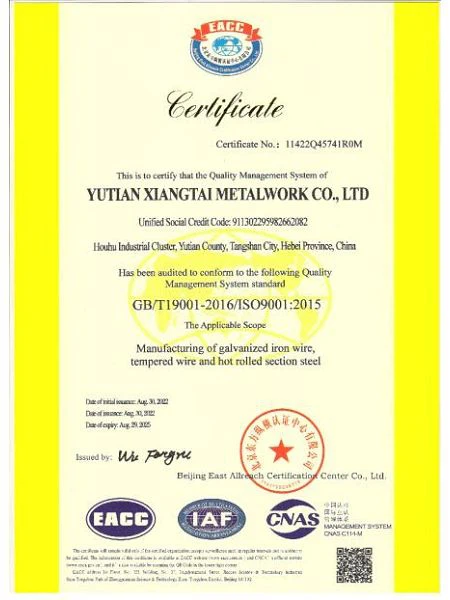
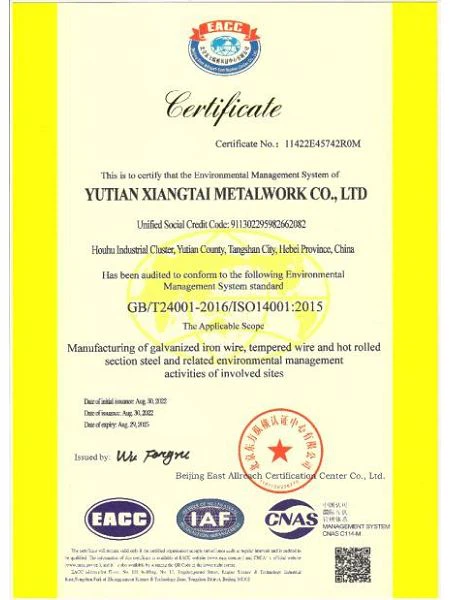
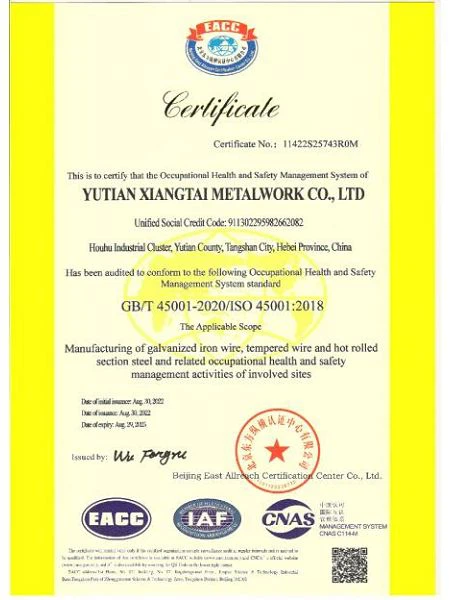
FAQ
As one of the leading annealed wire manufacturers and suppliers in China, we warmly welcome you to wholesale high-grade annealed wire for sale here from our factory. All customized products are with high quality and competitive price.
Hardware Nails, Annealed Wire Black, Black Annealed Wire 15mm