

Why Choose Us?
Quality products
We have advanced production and testing equipment, and our products meet various standards.
Rich experience
We have years of industry experience and a team of experienced engineers and technicians to ensure consistent precision and high quality of our products.
Reliable service
Our team is committed to providing reliable and consistent service, ensuring that you receive high-quality products and customer support from us every time.
Professional team
The company is in possession of numbers of senior engineers and has abundant technique power, well conditioned equipment and technology comes to perfection.

Annealing Wire, Also Known As Thermal Wire, Is A Type Of Wire That Has Been Heated And Then Cooled Slowly To Increase Its Flexibility, Strength And Durability. Here Are Some Advantages Of Annealing Wire.

Annealed wire is a soft and flexible wire that is widely used in the construction, agriculture, and packaging industries. To create this type of wire, a process called annealing is used.

Annealed wire is a staple product used in a variety of industries for its softness and flexibility. The production process of this wire is an intricate one that involves several steps to ensure that the wire is of the highest quality.

Annealed wire is an essential material used in a variety of industries, including construction, agriculture, and manufacturing. This type of wire is produced through a precise production process, which involves several stages to ensure high-quality results.
Annealing wire is a type of soft wire with good plasticity and high precision, widely used in the electronics, electrical, and communication industries. The production process of annealing wire includes material selection, drawing, annealing, pickling, washing, drying, and other steps.

Annealed wire is a type of soft and flexible wire that has undergone a process called annealing, which involves heating the wire and slowly cooling it down to make it more malleable. Annealed wire is commonly used in various industries, including construction, agriculture, and packaging. In this article, we will discuss the production process of annealed wire.

Annealing wire, commonly known as annealing silk or annealed wire, is widely used in various industries due to its high flexibility, strength, and reduced brittleness. In this article, we will discuss the various applications of annealing wire and how it contributes to the growth of different sectors.

Annealed wire is a type of metal wire that has been heat-treated to become more flexible and malleable. The process of producing annealed wire is known as "annealing" or "heat treatment". Annealed wire is widely used in construction, industrial and agricultural fields due to its flexibility and durability. The production process of annealed wire involves multiple steps, including wire drawing, cleaning, straightening, and finally, annealing.

Annealing wire is an important process in the production of various metal products. This process involves heating a wire to a high temperature and then slowly cooling it down. This process is known as annealing and is done to improve the ductility and strength of wires.
What Is Annealed Wire Black
Annealed wire black, also known as soft annealed wire or annealed iron wire, is a type of steel wire that has undergone the annealing process to increase its ductility and reduce its hardness. It is commonly used in various industries, such as construction, agriculture, and manufacturing.
5 Advantages of Annealed Wire Black
Annealed wire black wire, also known as soft annealed wire or annealed iron wire, is a type of steel wire that has undergone the annealing process to increase its ductility and reduce its hardness. It is commonly used in various industries, such as construction, agriculture, and manufacturing. Here are five advantages of using annealed wire black wire:
Improved ductility and flexibility: Annealing softens the wire, making it more pliable and easier to bend. This makes it suitable for applications requiring the wire to be twisted, tied, or shaped without breaking or cracking.
Enhanced corrosion resistance: Annealed wire black wire can be coated with a thin layer of oil or wax, which provides a level of protection against corrosion. This coating helps to prevent rusting and prolongs the life of the wire when used in damp or humid environments.
Easy to work with: The softened state of the wire makes it easier to cut, shape, and handle, which is an advantage in various applications like binding, baling, or tying materials together. It reduces the need for specialized tools and equipment, making it a cost-effective option for many industries.
High tensile strength: Despite its softer state, annealed wire black wire still maintains a high tensile strength that allows it to withstand a significant amount of force without breaking. This makes it suitable for applications requiring strength and durability.
Wide range of applications: Due to its versatility, annealed wire black wire can be used in various industries and applications, such as construction (reinforcing steel bars, binding materials), agriculture (fencing, trellises), packaging (baling of hay, strapping of boxes), and manufacturing (wire mesh, cables).
How Is Annealed Wire Black Made
Annealed wire black is cold drawn low carbon steel wire produced through an annealing heat treatment based on a controlled nitrogen atmosphere, assuring a completely scale-free surface. This process gives the wire the characteristic of high ductility. The annealing process takes a simple post drawn "bright basic" steel wire and heats it in an oven or kiln changing the chemical composition. This process softens the wire as well as changing its color from a silver to more black color.
Annealed wire black is one of the most popular baling wires in the recycling industry and because it's easy to use and reduces the burden on the employees. Annealed wire black is very resilient and doesn't corrode easily, which means it has a better shelf life. You can purchase this wire in bulk and store it in your facility without worry of rust or corrosion.
Annealed wire black is also more reliable and doesn't break easily so you won't have to deal with accidents during the tying process. It is specifically manufactured to endure pressure and bear the environmental conditions, which makes it ideal for the construction, agriculture, and recycling industry.
Annealed Wire Black Process
The type of baling wire and baler that a facility uses is largely dependent on the type of materials being recycled, the size of the bales being produced and the amount of bales produced per day. There are two types of baling wire used in the baling process:
Today's single-ram balers are producing heavier and denser bales. This means that the quality of annealed wire black is more important than ever before.
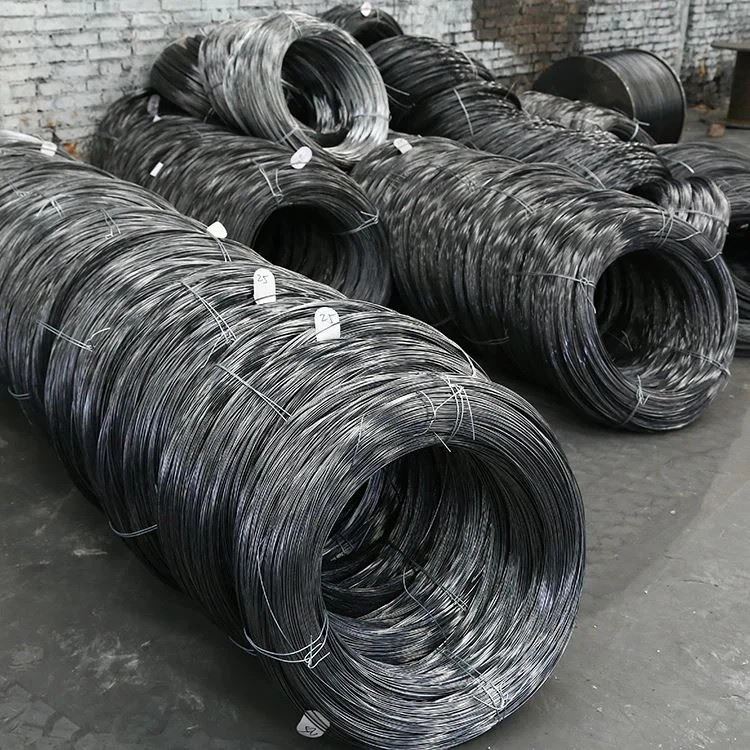
The annealing process occurs after wire is drawn from carbon steel rod to the desired diameter or gauge. The wire is heated in a furnace altering the microstructure of the wire, and then is slowly cooled. This process restores the ductility of the annealed wire black, providing for superior elongation, as well as changing its color from more of a rough grey or silver to the familiar black color.
Unlike galvanized baling wire, annealed wire black will rust if used and stored outdoors. Packing for the annealed wire black is on production stands for large throughput balers, and 50-pound and 100-pound box wire.
Galvanization is the process of coating or bathing drawn bright basic wire in a pool of molten zinc. This step occurs after the drawing process once the wire has been drawn to the desired diameter or gauge.
Galvanized baling wire is shiny silver in appearance with a smooth finish treatment, very little oil or residue to prevent rust. The galvanization process allows the baling wire to be used in wet and humid conditions without compromising its structural integrity and quality. Galvanized baling wire has a higher tensile strength with less elongation than annealed wire black. Galvanized wire is the most durable and versatile, and is recommended when storing your baled material in a location that has exposure to outdoor elements.
Annealed Wire Black as Tie/Baling Wire in Buildings, Parks, Daily
Annealed wire black is made of carbon steel wire, used for weaving, baling in general. Applied for home use and the construction.
Annealed wire black is obtained by means of thermal annealing, endowing it with the properties it needs for its main use - setting. This wire is deployed both in civil construction and in agriculture. Hence, in civil construction annealed wire black, also known as "burnt wire" is used for iron setting. In agriculture annealed wire black is used for bailing hay.
Annealed wire black for civil construction:
● The annealing of bare wire (wire which has simply been drawn) can be carried out in batches (bell-type furnace) or in line (in-line furnace).
Annealing is intended to return to the wire its ductility which it had lost during drawing.
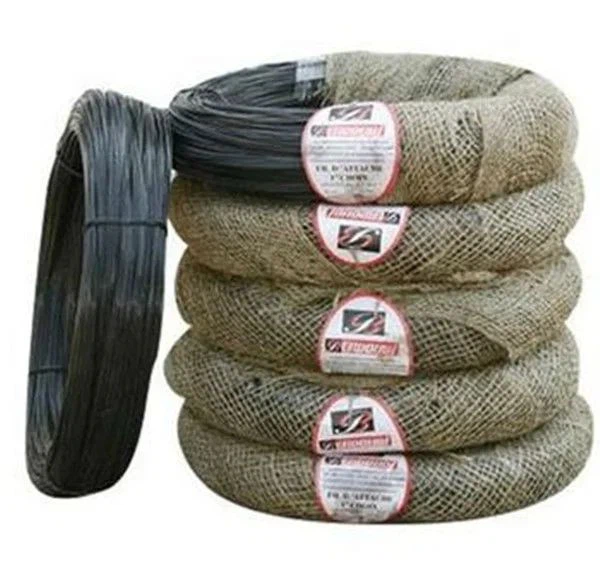
● Annealed wire black is stored in coils or spools of a varying weights and dimensions depending on the purposes for which it is intended and the needs of clients. The product does not usually have any type of protective lining, paper or plastic. We offer two kinds of annealed wire black, bright annealed and annealed wire black. Annealed wire black gets its name from its plain black color.
Soft annealed wire black offers excellent flexibility and softness through the process of oxygen free annealing.
● Packing: Spools, coils.
● Wire materials: Iron wire or carbon steel wire.
● Wire diameters: Similar to galvanized iron wire, from 5mm to 0.15mm (wire gauge 6# to 38#).
● Uses: Annealed wire black is mainly processed into coil wire, spool wire or big package wire. Or further straightened and cut into cut wire and u type wire. Annealed wire black is used as tie wire or baling wire in building, parks and daily binding.

Steps in Manufacturing the Black Annealed Wire
Purchasing the steel
We purchase rods made of 100% steel from trusted, family-owned mills. Low-carbon grades are used since lower carbon content produces softer, more flexible wire.
Preparation and drawing
● First, the wire rods undergo mechanical descaling to remove rust and mill scale.
● Then, we run our wire through a heavy-duty bull-block continuous wire drawing machine. The wire is run through progressively smaller dies to increase wire gauge (decrease diameter) and achieve the desired size.
Annealing
The three stages of annealing are:
● Recovery. The internal stresses and physical properties of the metal are recovered. The wire is heated to a specific temperature, which softens it and removes irregularities in the internal structure.
● Recrystallization. The wire is heated to a temperature above its recrystallization temperature but below its melting point. This temperature is maintained for a set period of time, during which deformed grains are replaced with stress-free grains.
● Grain growth. The wire is then air-cooled to allow the newly formed grains to harden into the desired crystalline structure and complete the process. The cooling process affects the wire's microstructure, allowing atoms to arrange themselves in a more regular manner, ultimately leading to reduced hardness and increased ductility.
The material may lose some of its strength during this stage, but it can be regained through subsequent quenching or tempering.
Surface coating
After the annealed wire has been cooled, a surface coating is often added (This is optional, coats all of their annealed wire products.). Surface treatments can improve corrosion resistance, aesthetic appearance, and magnetic properties of the wire.
We apply oil and wax to our black annealed wire. This layer of oil smooths the wire, helping it feed through high-volume baling machines. It also acts as a protective layer that increases the wire's lifespan.
Cutting and coiling
The finished wire is then cut or coiled. Baling wire products are often sold by weight, so the lengths we cut vary depending on the gauge of the wire and whether it will be sold by the box or stem.
The Advantages of Annealing Include
Improved mechanical properties
Annealing improves the structural integrity and flexibility of wires, making them more workable and better suited for baling applications that require flexible, ductile wire.
Enhanced electrical and magnetic properties
The heat treatment process improves conductivity and magnetism, which makes annealed wire a good choice for electric fencing.
Stress reduction
By relieving internal stresses built up during the drawing process, annealing reduces the risk of fatigue, fracturing, or cracking over prolonged periods of use.
Common Uses for Annealed Wire Black
From construction to automotive manufacturing
Where black annealed wire is utilized black annealed wire is used in various industries due to its increased flexibility and durability. In construction, it is often used for tying rebar together, while in automotive manufacturing, it can be found in wiring harnesses. The wire's malleability makes it useful for creating intricate shapes and designs that other types of wire could not handle.
Specific applications for annealed wire black in industries
In the construction industry, this type wire is commonly used as a tool for concrete reinforcement. Along with these uses, annealed wire blacks have been used in jewellery manufacturing due to their flexibility and strength. In automobiles, annealed wire blacks are found throughout the vehicle's electrical system.
Wiring harnesses are typically made from annealed copper wiring due to their high conductivity and ability to bend without breaking. It's also often used as a safety wire when fastening bolts prone to loosening due to vibrations.
The three stages of annealing are:
Recovery
The internal stresses and physical properties of the metal are recovered. The wire is heated to a specific temperature, which softens it and removes irregularities in the internal structure.
Recrystallization. The wire is heated to a temperature above its recrystallization temperature but below its melting point. This temperature is maintained for a set period of time, during which deformed grains are replaced with stress-free grains.
Grain growth. The wire is then air-cooled to allow the newly formed grains to harden into the desired crystalline structure and complete the process. The cooling process affects the wire's microstructure, allowing atoms to arrange themselves in a more regular manner, ultimately leading to reduced hardness and increased ductility.
The material may lose some of its strength during this stage, but it can be regained through subsequent quenching or tempering.
Surface coating
After the annealed wire has been cooled, a surface coating is often added (this is optional, but BWD coats all of their annealed wire products.). Surface treatments can improve corrosion resistance, aesthetic appearance, and magnetic properties of the wire.
We apply oil and wax to our black annealed wire. This layer of oil smooths the wire, helping it feed through high-volume baling machines. It also acts as a protective layer that increases the wire's lifespan.
Cutting and coiling
The finished wire is then cut or coiled. Baling wire products are often sold by weight, so the lengths we cut vary depending on the gauge of the wire and whether it will be sold by the box or stem.
Our Factory
In 30 years, two factories and a large trading company were established.Yutian
Hongtai Wire Co., LTD., Yutian XiangtalMetalwork Co.LTD., and Tangshan Fengrun District Hengwei Trading Co., LTD The company in line with the "pragmatic, dedicated, harmonious, win-win, innovation,development" work philosophy; External adhering to the "based on quality, integrity management,customer service,benefit one party, give back to the society business purpose,has achieved great development,showing a momentum of development, become a leading enterprise at the county level/promoting the development of local economy
Yutian Xiangtai Metalwork Products Co Ltd. has 30 years of production experience. ls a product and sales as one of the comprehensive private enterprises, more than 800 employees, including professional technology and management more than 100 people. The company's business products are galvanized wire, common nails, cold drawn wire,annealed wire, Channel steel, i-steel, the annual output of 3 million tons over the years the company by the high quality products, reliable reputation, good service radiation sales to organizing more than 200cities across the country.


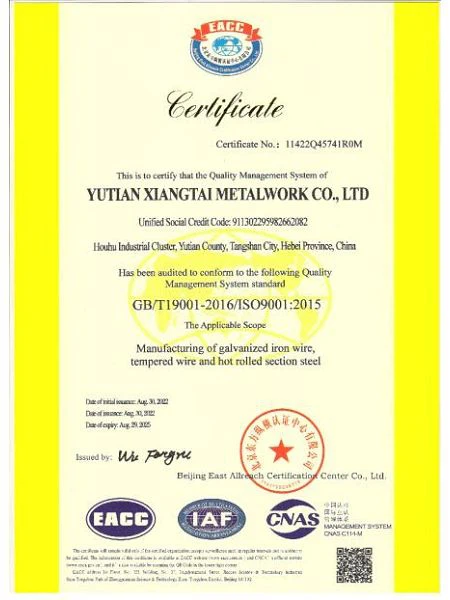
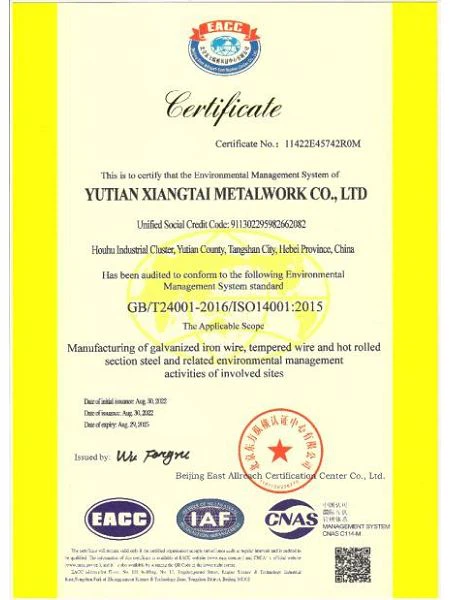
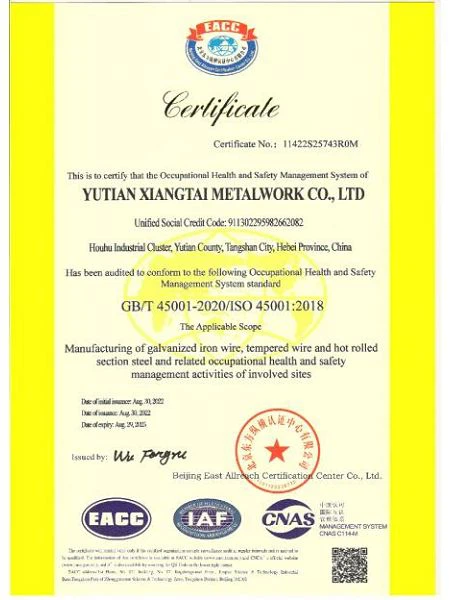
Our Certificate
FAQ
Hot Tags: annealed wire black, China annealed wire black manufacturers, suppliers, factory, 2mm Black Annealed Wire, Building Nail Common Nail, 16 Gauge Black Annealed Wire, Electro Galvanized Wire, Binding Galvanized Wire, Nails Common


