


Company Profile
Hongtai Wire Co., LTD., Yutian XiangtalMetalwork Co.LTD., and Tangshan Fengrun District Hengwei Trading Co., LTD The company in line with the "pragmatic, dedicated, harmonious, win-win, innovation,development" work philosophy; External adhering to the "based on quality, integrity management,customer service,benefit one party, give back to the society business purpose,has achieved great development,showing a momentum of development, become a leading enterprise at the county level/promoting the development of local economy
Why Choose Us
Advanced Equipment
A machine, tool or instrument designed with advanced technology and functionality to perform highly specific tasks with greater precision, efficiency and reliability.
Professional Team
Yutian Xiangtai Metalwork Products Co Ltd. has 30 years of production experience. ls a product and sales as one of the comprehensive private enterprises, more than 800 employees, including professional technology and management more than 100 people.
Rich Experience
The years the company by the high quality products, reliable reputation, good service radiation sales to organizing more than 200cities across the country.
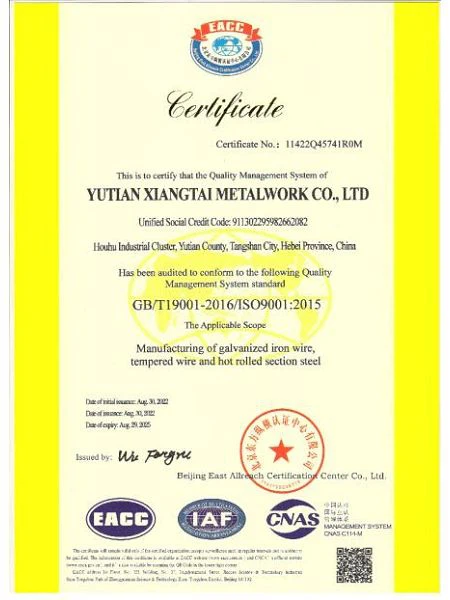
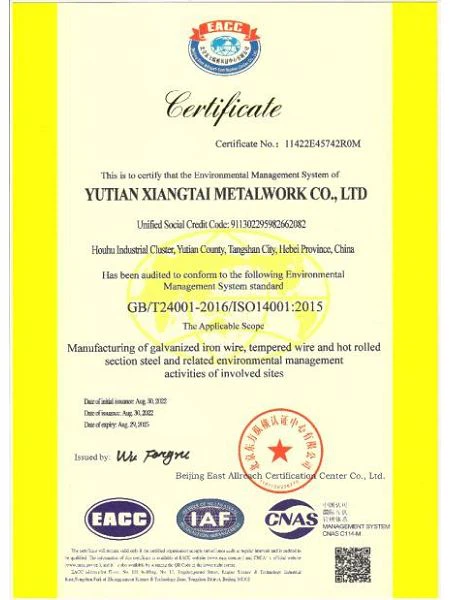
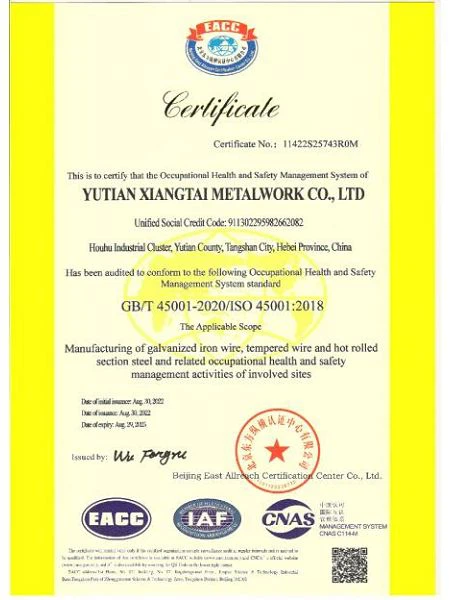
Certificate
The establishment of a solid contact with more than 1000 dealers and are exported to Europe, Africa, Middle East countries, by foreign dealer's consistent high praise. promote the local economic development We have been concentrated on quality management systemand our products have successfully passed the inspection and approval of IS09001

Color:Black
Packing:Woven Bag, Hessian cloth, Pallet or Custom
Tensile strength:350-550N/mm2

Annealed wire is a soft and flexible wire that is widely used in the construction, agriculture, and packaging industries. To create this type of wire, a process called annealing is used.
Annealed wire is an essential material used in a variety of industries, including construction, agriculture, and manufacturing. This type of wire is produced through a precise production process, which involves several stages to ensure high-quality results.

Annealing wire is a type of soft wire with good plasticity and high precision, widely used in the electronics, electrical, and communication industries. The production process of annealing wire includes material selection, drawing, annealing, pickling, washing, drying, and other steps.

Annealed wire is a type of soft and flexible wire that has undergone a process called annealing, which involves heating the wire and slowly cooling it down to make it more malleable.

Annealing wire, commonly known as annealing silk or annealed wire, is widely used in various industries due to its high flexibility, strength, and reduced brittleness. In this article, we will discuss the various applications of annealing wire and how it contributes to the growth of different sectors.

Annealed wire is a type of metal wire that has been heat-treated to become more flexible and malleable. The process of producing annealed wire is known as "annealing" or "heat treatment". Annealed wire is widely used in construction, industrial and agricultural fields due to its flexibility and durability.

Annealing wire, also known as tempering wire or thermally-stabilized wire, is a versatile material used in a wide range of industrial applications. The wire is made of various materials such as copper, aluminum, and stainless steel, and it can be used for a variety of purposes such as heating, soldering, and electronic applications.

Annealing wire is an important process in the production of various metal products. This process involves heating a wire to a high temperature and then slowly cooling it down.
What is 12 Gauge Annealed Wire
12 Gauge Annealed Wire is a metal wire that has undergone a specific heating and cooling process to increase its flexibility and durability. This process, known as annealing, involves heating the wire to a specific temperature and cooling it slowly to room temperature.
Annealing involves heating the wire to a specific temperature before cooling it at a prescribed rate in order to achieve the desired result.
Annealing is used with the goal of increasing the ductility of the wire and reducing the hardness. This allows the wire to be flexible while still remaining durable. With these properties, annealed wire is self-tying and can stay in place when wrapped around itself.
Annealing makes metals more formable
When metal is stronger and more ductile, it gives manufacturers more leeway in the fabrication process. There is less risk of material fracturing from bending or pressing.
Annealing can also improve a metal's ability to be machined and improve the lifespans of tools
Hard, brittle metals can cause wear to shop tools. Annealing metals reduces wear and the chance of damage to tools.
Annealing removes what's called residual stress
Residual stress is what remains in a metal after the original cause of the stress has been removed. For example, residual stress from roll forming could cause a structural to gape when cut with a band-saw. Residual stress can complicate future processes and annealing is a great way to remove it.
Easy to use
Black annealed wire is highly regarded as being an easy-to-use product. One of the main reasons for this is that it is compatible with nearly every baling machine available on the market.
Another factor that helps is that the annealed wire is coated with oil. As a result, the wire moves through the baling machine easier. This results in less potential for the wire to become stuck, ensuring efficiency levels can be maximized.
Versatility
The versatile nature of black annealed wire is another reason why it is highly regarded. This galvanized iron wire can be utilized in a wide manner of applications. It being used during the baling process is the obvious way in which this wire is applied.
Where a fence can be created with the wire to protect a property – particularly effective when combined with wire mesh. Another example is how annealed wire can be utilized as a support due to its high tensile strength. This means it can, say, keep art displays securely on a wall.
Flexibility
Adding to its usability, the flexibility of annealed wire is a further benefit for those who opt for this wire type. The annealing process makes the wire relatively soft, and this naturally increases its flexibility. The result: it is easier to manipulate the annealed wire into the required shape.
What Are the Different Types of 12 Gauge Annealed Wire
Annealing can be done with many different variations, each for a specific purpose. Most of the types of annealing dealt with below are relevant to alloys, and most frequently applied to steels. Listed below are the different types of annealing:


Stress Relief Annealing: Focuses on relieving the internal stresses in a metal component, usually used to correct any stresses that may have occurred during uneven cooling after casting. The metal is therefore heated up enough to allow the dislocations within the metal's crystal lattice to be removed and then cooled slowly in still air. No phase transitions occur in stress relief annealing.
Isothermal Annealing: The product of having accurate knowledge of an alloy's temperature-time diagrams. The focus of this type of annealing is to maximize machinability. The alloy is held above the recrystallization temperature for some time (in steel, to fully austenitize it), then the temperature is dropped rapidly to a lower temperature, and held at a constant temperature there, (to allow the controlled decomposition of the austenite).
Diffusion Annealing: Restores the homogeneity in the chemical composition of the alloy mix, eliminating segregation that may have occurred during casting. In steels, diffusion annealing fuses the iron and the carbide together. It is carried out at a high temperature, above the upper critical temperature, and held for a number of hours. Typically, further annealing may be required after diffusion annealing, in order to produce the desired grains.
Incomplete Annealing: Usually applied to hyper-eutectic steel. The steel is heated to around the upper basic temperature and then cooled slowly. It aims to achieve spherical pearlite within the hyper-eutectic steel, which has the benefits of improved machinability and decreased hardness.
Complete Annealing: Is carried out by heating above the upper critical temperature, and then cooling slowly in a very controlled manner. It requires complete knowledge of the isothermal transformation diagram and the cooling transformation diagram of the alloy so that the desired microstructure of the alloy is achieved.
Spherification Annealing: Focuses on achieving spheroid structures within the alloy. For high-carbon steels, this is created by forming carbide spheroids within ferrite. The purpose of this type of annealing is primarily to improve machinability, or else to assist in cold forming. Spherification annealing is usually carried out by heating the metal to below the lower critical temperature and holding it there for a number of hours. Cooling rates are not important.
Recrystallization Annealing: Causes new, undeformed grains to form within the alloy structure, which grows and consumes the previously deformed grains. This occurs without phase change. It is typically applied to steels that have been cold worked, to restore ductility and to provide control over grain structure. It is carried out by heating to just below the lower critical temperature for a prolonged period of time, and then cooling.
Applications of 12 Gauge Annealed Wire
Since 12 Gauge Annealed Wire has different chemical and physical properties than regular steel, it provides a few advantages in some applications. The 12 Gauge Annealed Wire manufacturing process gives it the flexibility necessary in many industries, including agriculture, construction, manufacturing and more.
Baling: use 12 Gauge Annealed Wire for baling hay, branches and other materials. 12 Gauge Annealed Wire is ideal for these applications because it is sturdy, yet flexible. 12 Gauge Annealed Wire will also stay in place once bent to a specific shape. Adding oil coating helps 12 Gauge Annealed Wire move smoothly through automatic baling machines.
Tying: Annealed steel wire helps secure various loads by allowing the materials to stretch and expand. For example, recycling centers tie bundles of scrap paper, cardboard and metal with 12 Gauge Annealed Wire. Manufacturers also use 12 Gauge Annealed Wire to bind, bale and tie their materials and products.
Packaging: Product manufacturers use 12 Gauge Annealed Wire to secure packages during shipping because the wire provides security and flexibility. Some facilities also use the material in wire mesh to create packaging molds.
Securing equipment: The mining industry sometimes uses 12 Gauge Annealed Wire to hold equipment in place.
The Process 12 Gauge Annealed Wire
Heat it up, cool it down
12 Gauge Annealed Wireis a heat treatment process used to alter metal wire's properties. During annealing, the wire is heated to a specific temperature and cooled down slowly. Heating causes the metal to become more malleable by relaxing its internal structure, while cooling allows for an even distribution of stress which increases its durability.
Temperature and Time Control
Controlling the temperature and timing of 12 Gauge Annealed Wireis crucial for achieving desired results. If the temperature is too low, the metal won't be soft enough; if it's too high, it'll become brittle and prone to breaking. Similarly, if the wire isn't heated long enough or cooled too quickly, it might not achieve the desired level of elasticity and strength.
Batch Vs Continuous Annealing
There are two primary methods of annealing: batch 12 Gauge Annealed Wireand continuous annealing. Batch 12 Gauge Annealed Wireinvolves heating a set amount of wire in batches before cooling them. It's ideal for small-scale production or when different types of wires require different temperatures or durations of heating.
On the other hand, continuous 12 Gauge Annealed Wireinvolves passing the wire through an oven that heats them as they're moving forward on a conveyor belt-like system before being cooled on another conveyor belt on the other side. This method has a higher production rate than batch annealing. Still, it requires all wires to be made from similar materials or alloys with similar requirements for the heating duration and temperature ranges.
- First, the drawn mild steel wire is placed in an 12 Gauge 12 Gauge Annealed Wiretank or 12 Gauge 12 Gauge Annealed Wirefurnace;
- Then it is heated to the right temperature and slowly cooled;
- Finally, oil is applied to prevent rusting and to facilitate distribution through the machine.
Determine A Reasonable 12 Gauge 12 Gauge Annealed WireTemperature
When the 12 Gauge 12 Gauge Annealed Wireprocess is carried out, the 12 Gauge 12 Gauge Annealed Wiretemperature should be determined between 800~850℃. If the wire before cold-drawing uniform organization, fine grain, can be used 600 ~ 700 ℃ recrystallization annealing. For coarse diameter wire, commonly used sub-temperature 12 Gauge 12 Gauge Annealed Wire(Ac1 ~ AC3 between the temperature) to eliminate process hardening, and refine the uniform organization.
Determining the Holding Time
The wire material moves from 750 to 800°C after entering the 12 Gauge 12 Gauge Annealed Wirefurnace. The time of movement is the holding time. The 12 Gauge 12 Gauge Annealed Wiretemperature of the nickel-aluminum composite wire can be controlled by setting the temperature at the temperature measurement point of the 12 Gauge 12 Gauge Annealed Wirefurnace. In general, the temperature is set at 810°C, and the holding time is 8 hours. Then after a period of air-cooling and the application of lubricant, the wire can be coiled smoothly. After this treatment, the cold-drawn wire is moderately soft and hard, without bending and twisting.
How to Maintain 12 Gauge Annealed Wire
Maintaining annealed wire involves regular inspection and handling to preserve its properties and ensure longevity. Here are key steps to properly care for annealed wire:
Inspection
Regularly inspect the wire for any signs of rust, corrosion, or damage. Look for cuts, abrasions, or discoloration that could indicate compromised integrity.
Examine the wire for deformation or kinking, which can occur during handling or storage.
Storage
Store the wire in a dry environment to prevent exposure to moisture, which can lead to corrosion. Use a covered storage area or enclosures that protect against humidity and condensation.Keep the wire away from direct sunlight and extreme temperatures, as these can degrade the material over time.Avoid storing annealed wire near corrosive substances or chemicals that could react with the metal.
Handling
Handle the wire with care to avoid causing kinks, twists, or bends that can weaken the structure. Use gloves when necessary to prevent fingerprints or oils from transferring to the wire.When cutting the wire, use appropriate tools to make clean cuts without creating jagged edges that could snag or tear other materials.
Winding and Coiling
When coiling the wire, ensure that the coils are not too tight, as this can induce stress and potentially alter the wire's properties. Loose, even coils are ideal.Avoid overlapping coils, which can lead to uneven distribution of stress and potential breakage.
Safety and Compliance
Adhere to safety regulations and industry standards when handling and storing annealed wire to ensure the well-being of personnel and the quality of the product.If the wire is used in critical applications, such as electrical systems, ensure it meets the required specifications and certifications.
Regular Maintenance
Implement a regular maintenance schedule to inspect the wire and address any issues promptly. This schedule should be based on the frequency of use and the severity of the operating conditions.
Hongtai Wire Co., LTD., Yutian XiangtalMetalwork Co.LTD., and Tangshan Fengrun District Hengwei Trading Co., LTD The company in line with the "pragmatic, dedicated, harmonious, win-win, innovation,development" work philosophy


Our Certificate
FAQ
Hot Tags: 12 gauge annealed wire, China 12 gauge annealed wire manufacturers, suppliers, factory, Nail Wire, 12 Gauge Annealed Wire, 2mm Black Annealed Wire, Wire Nails, Black Annealed Wire, Q195 Annealed Wire


