

Why Choose Us?
Quality products
We have advanced production and testing equipment, and our products meet various standards.
Rich experience
We have years of industry experience and a team of experienced engineers and technicians to ensure consistent precision and high quality of our products.
Reliable service
Our team is committed to providing reliable and consistent service, ensuring that you receive high-quality products and customer support from us every time.
Professional team
The company is in possession of numbers of senior engineers and has abundant technique power, well conditioned equipment and technology comes to perfection.
What Is Galvanized Wire Mesh
Galvanized mesh is made by dipping steel mesh into molten zinc. The process forms a zinc-steel alloy coating, which gives the material exceptional strength and weather resistance. As such, it's a go-to for various outdoor projects.

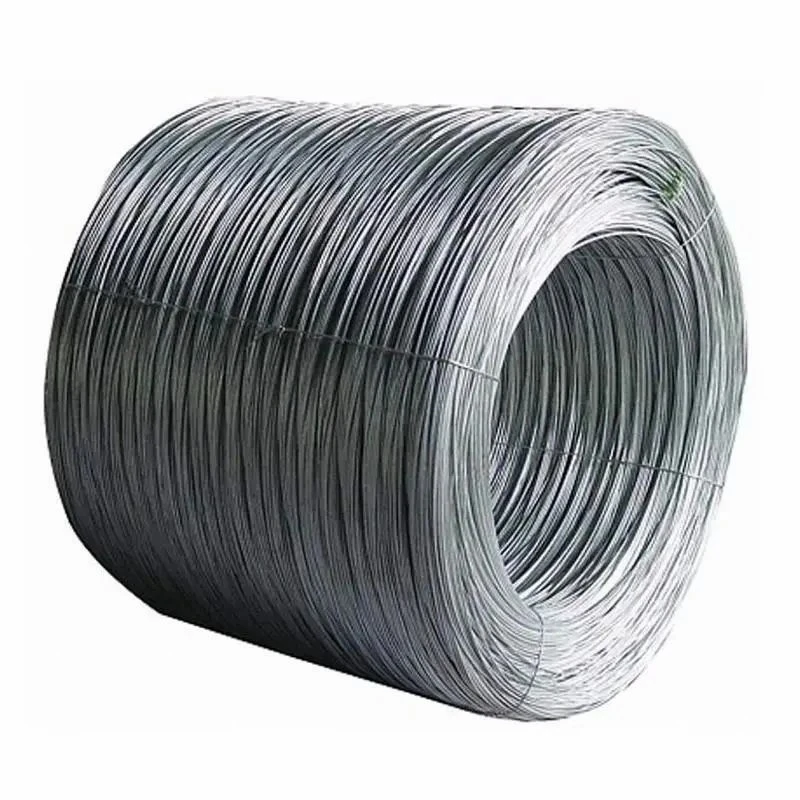
Galvanized wire is a type of wire that has undergone a galvanizing process to protect it from corrosion and improve its durability. This process involves coating the wire with a layer of zinc, which creates a barrier between the wire and the element

Galvanized wire, also known as coated wire, is made of high-quality low-carbon steel wire with a zinc coating applied to its surface. The galvanization process helps to improve the wire's corrosion resistance, making it ideal for use in a wide variety of applications.

Galvanized wire is a type of wire that has been coated with a layer of zinc to prevent rusting and increase durability.

Galvanized wire is a type of wire that has been coated with zinc in order to protect it from rust and corrosion. Galvanized wire is highly durable and can be used for a wide range of applications, including fence building, agricultural applications, and construction projects.

Galvanized wire is a type of wire that has been coated with a layer of zinc to prevent rusting and increase durability.

Galvanized iron wire, also known as electro galvanized wire or hot-dipped galvanized wire, is a type of steel wire that has undergone a galvanization process to prevent rust and corrosion. The process involves coating the wire in a protective layer of zinc, which forms a barrier against moisture, chemicals, and other environmental factors that can cause damage to the wire.

Zinc-coated iron wire, also known as galvanized iron wire, is a popular product in the wire industry. It is used in various applications, such as construction and agriculture.

Galvanized wire is a type of wire that has been coated with a layer of zinc to prevent rusting and corrosion. This wire is widely used in various applications such as fencing, construction, agriculture, and packaging. The advantages of galvanized wire are numerous, making it a preferred choice for many industries.

Galvanized wire, also known as galvanized iron wire, is a type of steel wire that has been coated with a layer of zinc to prevent rust and corrosion.
The Benefits of Galvanized Wire Mesh
Used for variety of purposes
Galvanized wire mesh is a great product for consumers because it is extremely versatile and can be used for a variety of purposes. For example, it can be used as an external screen enclosure for phones, or to protect property from theft or vandalism.
Durable & long lasting
Additionally, galvanized wire mesh is also very durable and long lasting, making it a great investment for consumers. In fact, many people consider galvanized wire mesh to be one of the best investments they have ever made.
Affordable
Galvanization is a process in which a wire mesh is coated with a galvanizing agent. The purpose of this process is to protect the wire mesh from corrosion.
Applications for Galvanized Wire Mesh
Wire mesh is a versatile material that can be used for a variety of purposes.
Galvanized wire mesh is most commonly used for fencing purposes. It is particularly popular for use in residential and commercial settings, as it provides a high level of security and protection against corrosion.
In addition to being used for fencing, galvanized wire mesh can also be found as component parts of other industrial applications, such as warehouses and manufacturing plants.
Some other applications of wire mesh include staining and screening. Galvanized wire mesh is available in different gauges and sizes, making it suitable for a wide range of applications. It is important to choose the right type of wire mesh for the intended application, as each type has specific benefits and drawbacks.
10 Outdoor Uses for Galvanized Wire Mesh
Galvanized mesh is made by dipping steel mesh into molten zinc. The process forms a zinc-steel alloy coating, which gives the material exceptional strength and weather resistance. As such, it's a go-to for various outdoor projects.
Galvanized wire mesh can be used for many outdoor residential projects. These include fencing and enclosures, compost bins, pest control, gutter guards, chicken coops, tree guards, cloches and cages, trellises, garden arches, and gabions.
Fencing and Enclosures
Galvanized wire mesh panels can be attached to wood beams and made into a sturdy fence for a front yard or back patio. The material can also be used for garden fencing to keep pets and other curious nibblers out.
Compost Bins
If you have metal mesh sheets, tin snips, and some loose wire, you don't need to buy a pre-made outdoor compost bin. You can make your own using more malleable mesh or secure four rigid galvanized screens together to create a square bin.
Pest Control
Hardware cloth can be used for a wide range of pest-control measures. Beyond animal fencing, this includes below-ground anti-burrowing barriers and enclosures for outdoor firewood stacks. You can also install screens over your foundation vents and soffits to keep critters out of your home.
Gutter Guards
Mesh guards prevent sticks, leaves, and other debris from clogging and overflowing your channels, which could lead to a flooded home or a rotted roof. But that's not all they're good for. They can also prevent squirrels, rats, snakes, and bugs from making their way into your gutters.
Chicken Coops
Many assume chicken wire (also known as hex mesh) is the best option for chicken coops. However, it might not be durable enough to deter foxes, snakes, coyotes, and other predators. As it turns out, the galvanized variety is ideal for henhouses, thanks to its thick wire diameter and exceptional durability.
Tree Guards
The trees on your property could be subject to damage from buck deer sharpening their antlers on the trunks or beavers and other rodents feeding on the bark. To prevent wildlife wear and tear, consider DIY tree guards. This solution is affordable, environmentally friendly, and lasts for several years.
Cloches and Cages
Cloches are dome-shaped wire mesh covers that safeguard seedlings and plants from pests and wildlife.
Galvanized mesh is a go-to for gardeners, who often use the material to create vegetable cages and cloches. The latter is a dome-shaped cover that safeguards seedlings and sprouts from nibbling wildlife and curious pets.
Trellises
Galvanized wire can also come in handy for DIY trellises. Whether free-standing or attached to a wall, these vertical structures are usually made of wood and feature a wire mesh backing.
Garden Arches
Arches can act as designated garden entrances or help frame in landscaping-but they offer more than just aesthetics. These vaulted structures can support various climbing plants, like wisteria, jasmine, ivy, honeysuckle, and roses.
Gabions
Galvanized wire mesh has been used to create a round gabion filled with plants. Heavy-duty metal mesh is a key material for gabions. These stone-filled metal cages can be functional, decorative, or a little of both. For instance, you can build a gabion retaining wall that doubles as a bench or make a round fire pit for your back patio.
With a lifespan upwards of 50 years, galvanized wire costs less than other wire products and lasts longer than them too. What's more, on top of having a really long lifespan, those who choose galvanized wire will come to realize its also very low maintenance due to its strong protective outer layer. Zinc protects the steel, preventing damage to the wire core by the elements. The zinc-steel alloy on galvanized wire mesh strengthens the material while keeping rust and corrosion at bay-but the protective coating will eventually wear off. The primary reason why people use galvanized metal is that it offers them rust and corrosion protection. When iron reacts to oxygen during moist and wet conditions, it will create rust as a byproduct. Covering wires in a zinc coating will have a shield that prevents further rust from occurring.
Type of galvanized wire meshA thick, robust outer layer of zinc is what makes galvanized hardware cloth so strong and resilient. How does it acquire this coating? It can be done in a couple of ways: hot-dipping and electrogalvanizing. Each process is outlined below.
● Hot-Dipping
The stainless steel is cleaned with a sodium hydroxide solution to remove dirt, debris, oil, and other residues.
An acidic solution is then used to remove any mill scale, rust, contaminants, and other surface impurities.
A zinc ammonium chloride cleaning agent (also known as a "flux") is applied to the surface to prevent oxidation. This solution remains on the steel, as it helps the zinc stick.
Next, the stainless steel is dipped into a vat of molten zinc (which has been liquified at an extremely high temperature).
The steel remains in the vat until it reaches the same temperature as the hot zinc.
After being removed from the vat, the stainless steel is rapidly cooled in a special tank.
Hot-dip galvanizing creates a physical and chemical bond between the steel and the zinc. This is what's called a zinc-steel alloy.
● Electrogalvanizing
Unlike hot-dipping, electrogalvanizing (or electrolytic galvanizing) is a cold process. Zinc particles are used to create an organic solvent, which is applied to the steel surface.
This causes a reaction between the substances, resulting in a zinc-steel alloy. When the solvent evaporates, the zinc remains on the metal. Electrogalvanizing generally leaves a thinner zinc layer than the hot-dipping method.
● Spangle
When larger pieces of steel are galvanized, the zinc coating can often be seen with the naked eye. This is what's called "spangle," which has a crystalized, snowflake-like appearance. The crystallites are present with wire mesh screens, but they're usually too small to see.
● Galvanizing Before vs. After Manufacturing Mesh
Stainless steel can be galvanized either before or after it's fabricated into wire mesh. When galvanizing occurs first, the metal is drawn down the desired diameter. The individual metal wires are coated with zinc and then woven or welded into screens. Welding can burn the zinc layer off at the joints, in which case it may need to be galvanized again.
When fabrication comes first, pre-woven steel products are dipped into molten zinc or coated with a solvent.
Due to its notable durability and corrosion-resistance, the material is an important component of many industrial applications.
galvanized wire mesh are used for:
● Agriculture and farming
● Archaeology
● Fencing, enclosures, and safety
● Gardening, greenhouses, and landscaping
● Gutter guards, soffit screens, and foundation vents
● HVAC applications
● Particle
● Pest-control
● Retention walls
● Roofing, ceilings, infill panels, drywall, and insulation
What Causes Galvanized Wire Mesh to Rust or Corrode
Rust can accumulate more rapidly if the material is continuously exposed to moisture, salt water, and certain chemicals.
For instance, galvanized steel may rust or corrode quickly in:
● Applications in which the material is continuously wet, such as a car wash or water park.
● Humid climates with lots of moisture in the air.
● Marine environments with exposure to saltwater and moist, salty air.
● Outdoor locations with frequent, heavy rainfall.
The Benefits of Galvanization
Increased lifespan
Galvanized wire mesh has a longer lifespan than regular wire mesh, due to the protection it provides against corrosion.
Reduced maintenance costs
Galvanized wire mesh requires less maintenance than regular wire mesh, as it does not corrode as easily. This means that there are fewer opportunities for problems to occur, and maintenance costs are reduced overall.
Improved safety
Galvanized wire mesh is much safer than regular wire mesh when it comes to preventing accidents and injuries. This is because it is more difficult for people or animals to get through the fence material, which reduces the risk of accidents occurring.
Did You Know These 5 Facts About Galvanised Wire
Cost efficient
Less expensive than other wire products, galvanized wire is cost-efficient. With an ability to be produced in mass quantities at a relatively low cost, it's a no-brainer to purchase galvanized wire for your next project or business venture.
Long lasting
With a lifespan upwards of 50 years, galvanized wire costs less than other wire products and lasts longer than them too. What's more, on top of having a really long lifespan, those who choose galvanized wire will come to realize its also very low maintenance due to its strong protective outer layer.
Zinc protects best
Galvanized wire that is coated with zinc is by far the best option and most effective compared to wire coated in paint or enamel. Even when zinc is scratched or eroded, it still protects the steel underneath and exposed areas. Zinc provides a greater electronegativity than other materials, which makes it the best protectant.
Reliable performance
As we stated before, galvanized wire is reliable with a permanently bonded tough coating of zinc. It does not shrink, warp, or twist unlike other materials and superior to plain steel.
Withstand the elements
Galvanised materials react well with other metals, acid, chemicals, and can withstand even the toughest outdoor elements. This makes galvanized wire a top choice for construction companies.
Our Factory
In 30 years, two factories and a large trading company were established.Yutian
Hongtai Wire Co., LTD., Yutian XiangtalMetalwork Co.LTD., and Tangshan Fengrun District Hengwei Trading Co., LTD The company in line with the "pragmatic, dedicated, harmonious, win-win, innovation,development" work philosophy; External adhering to the "based on quality, integrity management,customer service,benefit one party, give back to the society business purpose,has achieved great development,showing a momentum of development, become a leading enterprise at the county level/promoting the development of local economy
Yutian Xiangtai Metalwork Products Co Ltd. has 30 years of production experience. ls a product and sales as one of the comprehensive private enterprises, more than 800 employees, including professional technology and management more than 100 people. The company's business products are galvanized wire, common nails, cold drawn wire,annealed wire, Channel steel, i-steel, the annual output of 3 million tons over the years the company by the high quality products, reliable reputation, good service radiation sales to organizing more than 200cities across the country.


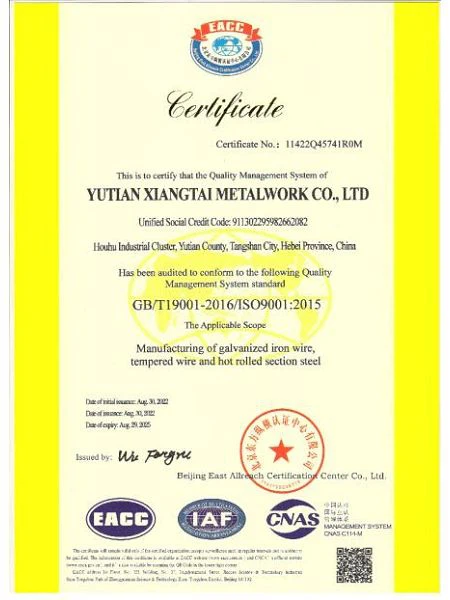
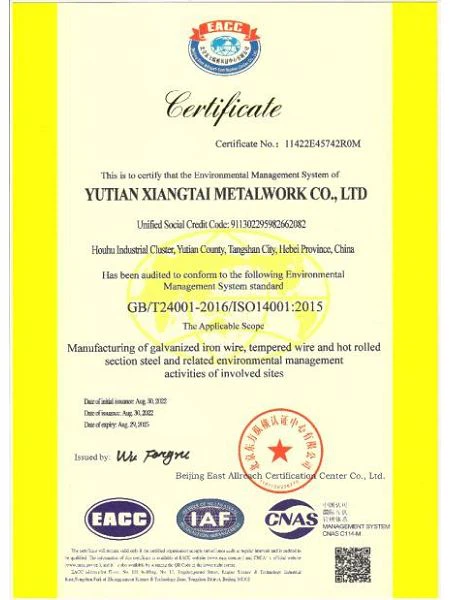
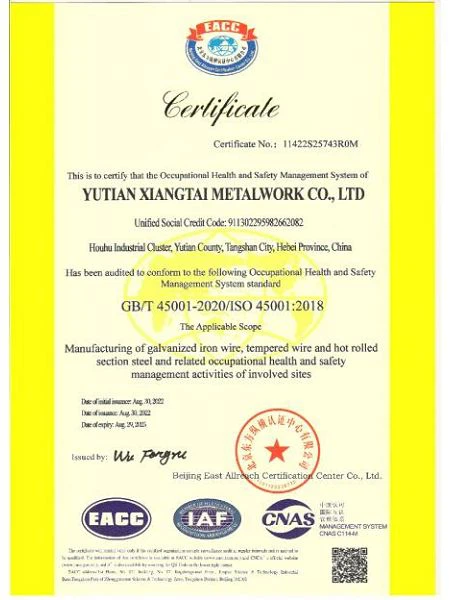
Our Certificate
FAQ
Hot Tags: galvanized wire mesh, China galvanized wire mesh manufacturers, suppliers, factory, 16 Gauge Black Annealed Wire, Galvanized Wire 2 mm, Common Wire Nail, Black Annealed Wire, Nail Wire, 4mm Black Annealed Wire


